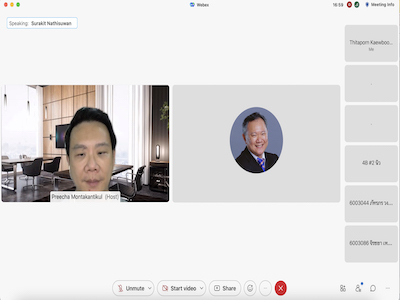
On Thursday night, December 23, 2021, from 07.00 p.m. - 09.00 p.m., MUPY’s Division of Undergraduate Education and Division of Student Affairs jointly organized an online gathering called Let’s Talk Together for MUPY’s undergraduate students via the Cisco Webex Meetings platform. This virtual meeting was presided over by MUPY’s Dean, Assoc. Prof. Surakit Nathisuwan. Also joined this event included the Deputy Dean for Education, namely Assoc. Prof. Preecha Montakantikul, and the Deputy Dean for Student Affairs and Quality Development, namely Assist. Prof. Dr. Luerat Anuratpanich.
This online meeting was arranged for the 2th-year to the 6th-year students with the aim of providing the latest information about teaching and learning methods for the second semester of the 2021 academic year. This virtual gathering was attended by more than 150 undergraduate students. Besides, this activity helped support Sustainable Development Goals (SDGs) in terms of Quality Education to ensure inclusive and equitable quality education and promote lifelong learning opportunities for all, and the 10th Goal: Reduce inequality within and among countries.

The ultimate success of a pharmacist's practice relies on applying expertise to minimize the consumer's risk of harm from medication while maximizing the positive outcomes in disease prevention and treatment.
Division of Information Technology and Instructional Media, Faculty of Pharmacy, Mahidol University.
Cookie Notice
This site uses cookies from us and our partners to make your browsing experience more efficient, relevant, convenient and personal. In some cases, they are essential to making the site work properly. By accessing this site, you direct us to use and consent to the use of cookies. You can change your settings by clicking on the Cookie Settings link.
Cookie Settings
When you visit any website, it may store or retrieve information on your browser, mostly in the form of cookies.
This information might be about you, your preferences or your device and is mostly used to make the site work as you expect it to.
The information does not usually directly identify you, but it can give you a more personalized web experience.
Because we respect your right to privacy, you can choose not to allow some types of cookies.
Click on the different category headings to find out more and change our default settings.
However, blocking some types of cookies may impact your experience of the site and the services we are able to offer.
These are cookies that are technically required for the operation of the Sites. They are usually only set in response to actions made by you which amount to a request for services, such as setting your privacy preferences, logging into secure areas of the Sites or filling in forms. These cookies store data such as online identifiers (including IP address and device identifiers) along with the information used to operate the Sites. We may estimate your geographic location based on your IP address to help us display the content available in your location and adjust the operation of the Sites.
These cookies allow us to recognize and count the number of visitors and to see how visitors move around the Sites when they use them. This helps us to understand what areas of the Sites are of interest to you and to improve the way the Sites work, for example, by helping you find what you are looking for easily. We may use third party web analytics providers to help us analyze the use of the Sites, email, and newsletters. These cookies store data such as online identifiers (including IP address and device identifiers), information about your web browser and operating system, website usage activity information (including the frequency of your visits, your actions on the Sites and, if you arrived at any of the Sites from another website, i.e. the URL of that website), and content-related activity (including the email and newsletter content you view and click on).