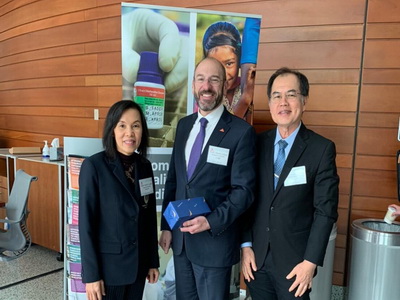
As official delegation representing MUPY, Assoc. Prof. Satit Puttipipatkhachorn and Prof. Leena Suntornsuk actively took part in the launch event and technical workshops of the “Promoting the Quality of Medicines Plus (PQM+)”, a 5-year, $160 million USD cooperative agreement led by the United States Pharmacopeia (USP) and funded by the U.S. Agency for International Development (USAID). The event was held at the United States Pharmacopeia’s headquarter in Rockville, Maryland, USA during February 24-26, 2020.
PQM+ aims to sustainably strengthen medical product quality assurance systems in low- and middle-income countries (LMIC), particularly in Africa and Asia. This is to ameliorate the global issues of poor-quality medical products that put millions of people living in LMIC at increased risk of illness or death and waste precious health system resources. The operators of this project are the Faculty of Pharmacy and the WHO Collaborating Centre (WHO-CC) for Antimicrobial Resistance (AMR) of the Faculty of Medicine at Siriraj Hospital.
The key goals of this project are 1) to strengthen governance for medical product quality assurance systems 2) to improve regulatory systems related to the quality of medical products 3) to optimize the allocation and use of resources 4) improve the supply of quality-assured medical products 5) to advance the global learning, policy, and operational agenda for medical product quality assurance.
The PQM+ consortium includes core partners IntraHealth International, IQVIA Government Solutions, Panagora Group, and African Union Development Agency–New Partnership for Africa’s Development (AUDA-NEPAD); as well as locally based partners Muhimbili University of Health and Allied Sciences; Center for Drug Discovery, Development and Production at the University of Ibadan; Addis Ababa University School of Pharmacy-Regional Bioequivalence Center; Ecumenical Pharmaceutical Network; Mahidol University; and Association of Southeast Asian Nations Network for Drugs, Diagnostics and Vaccines Innovation (ASEAN-NDI); as well as several technical resource partners.
The roles of Mahidol University are to provide technical assistance on Good Manufacturing Practice (GMP), regulatory science of medicinal products, quality control and quality assurance, antimicrobial resistance surveillance and management. The expected targets of our coverage are LMIC countries in Asia. This project will help increase Mahidol University’s international visibility especially in the area that threaten the issue of global health like quality of medicinal products and antimicrobial resistance. In addition, another key benefit is to increase the capacity of the university to be able and eligible to secure USAID funding directly in the future after the completion of the PQM+ program.

The ultimate success of a pharmacist's practice relies on applying expertise to minimize the consumer's risk of harm from medication while maximizing the positive outcomes in disease prevention and treatment.
Division of Information Technology and Instructional Media, Faculty of Pharmacy, Mahidol University.
Cookie Notice
This site uses cookies from us and our partners to make your browsing experience more efficient, relevant, convenient and personal. In some cases, they are essential to making the site work properly. By accessing this site, you direct us to use and consent to the use of cookies. You can change your settings by clicking on the Cookie Settings link.
Cookie Settings
When you visit any website, it may store or retrieve information on your browser, mostly in the form of cookies.
This information might be about you, your preferences or your device and is mostly used to make the site work as you expect it to.
The information does not usually directly identify you, but it can give you a more personalized web experience.
Because we respect your right to privacy, you can choose not to allow some types of cookies.
Click on the different category headings to find out more and change our default settings.
However, blocking some types of cookies may impact your experience of the site and the services we are able to offer.
These are cookies that are technically required for the operation of the Sites. They are usually only set in response to actions made by you which amount to a request for services, such as setting your privacy preferences, logging into secure areas of the Sites or filling in forms. These cookies store data such as online identifiers (including IP address and device identifiers) along with the information used to operate the Sites. We may estimate your geographic location based on your IP address to help us display the content available in your location and adjust the operation of the Sites.
These cookies allow us to recognize and count the number of visitors and to see how visitors move around the Sites when they use them. This helps us to understand what areas of the Sites are of interest to you and to improve the way the Sites work, for example, by helping you find what you are looking for easily. We may use third party web analytics providers to help us analyze the use of the Sites, email, and newsletters. These cookies store data such as online identifiers (including IP address and device identifiers), information about your web browser and operating system, website usage activity information (including the frequency of your visits, your actions on the Sites and, if you arrived at any of the Sites from another website, i.e. the URL of that website), and content-related activity (including the email and newsletter content you view and click on).